When is Gai Jatra in 2027?
Gai Jatra is listed for Wednesday 18 August 2027 by CalendarLabs, qppstudio and Office Holidays. All three call it a Kathmandu Valley holiday. The official 2084 BS holiday list hadn’t been published when we checked, as of November 2026, so treat the date as very likely and confirm it close to travel.
The date follows the moon. Spotlight Nepal says Gai Jatra starts on the day after Janai Purnima (the sacred thread full moon), and CalendarLabs lists Janai Purnima on 17 August 2027, so the two fit together. In 2026, Gai Jatra fell on Saturday 29 August, according to Hamro Patro and the government holiday notice.
| Source | Date given for 2027 |
|---|---|
| CalendarLabs | Wednesday 18 August, Kathmandu Valley |
| qppstudio | Wednesday 18 August, Kathmandu Valley, elsewhere for the Newar community |
| Office Holidays | Wednesday 18 August, regional holiday, Kathmandu Valley |
Bhaktapur doesn’t always match Kathmandu. The Kathmandu Post reported that in 2023, Bhaktapur marked Gai Jatra on 31 August, while Kathmandu and Lalitpur marked it on 1 September. If Bhaktapur is your main reason to go, check its date separately.
What is Gai Jatra?
Gai Jatra is a Newar festival in the Kathmandu Valley that remembers people who died in the past year. Wikipedia says the Nepali name translates the Newar one, and that the Newar word sā means cow. In Nepal Bhasa, the Newar language, it’s called Sa Paru or Saya. The Kathmandu Post explains that “Sa” means cow and “Paru” means the first day of a lunar fortnight.
Families who lost someone that year take part, and the cow is at the centre. Spotlight Nepal says cows are believed to guide the souls of the dead into the afterlife. The Kathmandu Post adds that Hindu Newars hope to help their relatives cross the Vaitarani, a river in Hindu belief that the dead must cross.
Where did it come from?
The popular story credits King Pratap Malla of Kathmandu, in the 17th century. Wikipedia and The Himalayan Times say that after his young son died, he asked people to parade and perform comedy to cheer up the grieving queen.
Historians question that story. The Kathmandu Post quotes a heritage documentarian who says the festival is older and began as a celebration of nature and cows. Wikipedia cites a historian who links it to Jayasthiti Malla of Bhaktapur in the 14th century. Cultural historians quoted by the Post also say the procession once worked as a yearly count of the dead, with courtiers tallying the families at Hanuman Dhoka.

What happens in the cow procession?
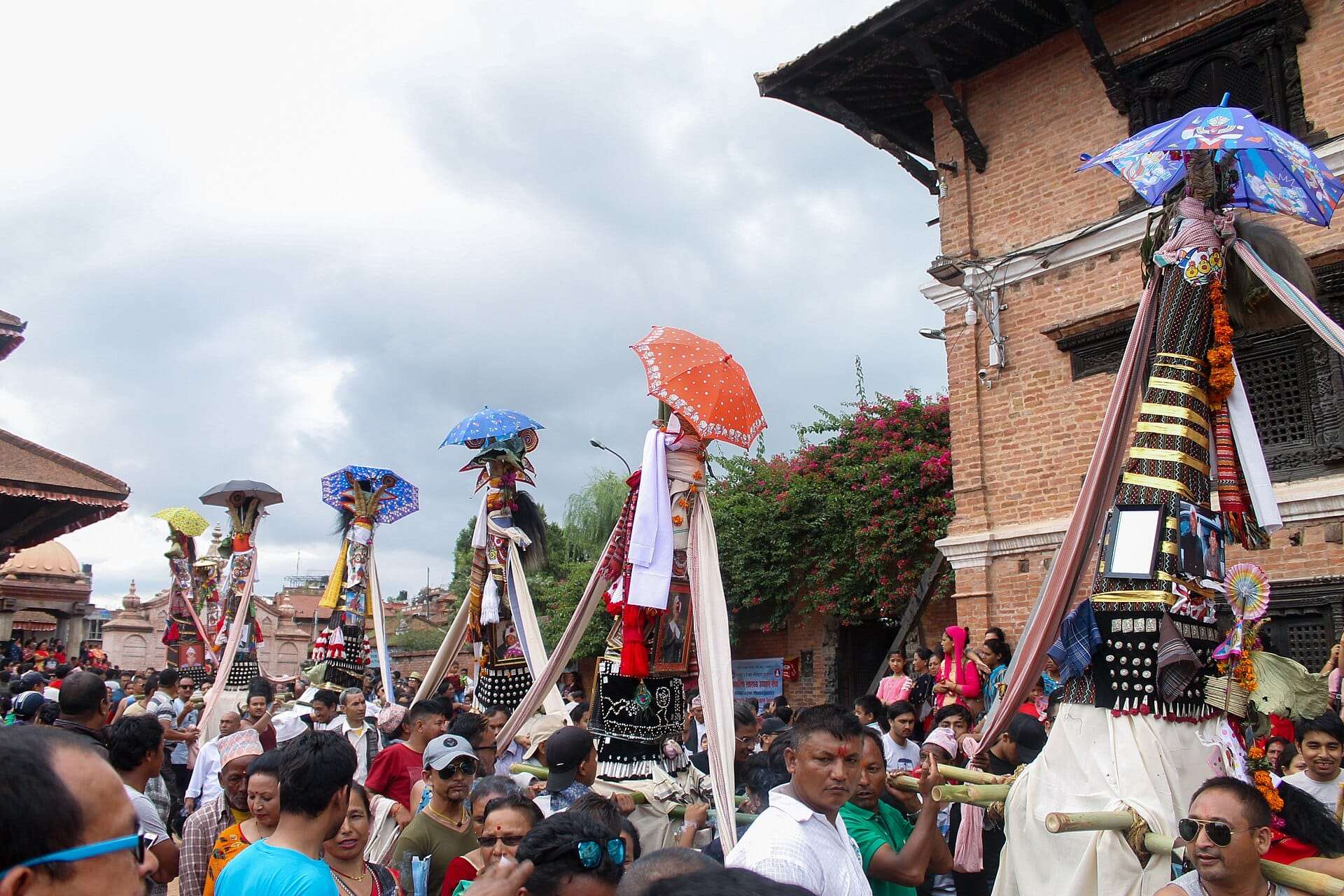
Each bereaved family sends a procession through the streets in the morning, usually with a family member dressed as a cow. The details differ by family and by city.
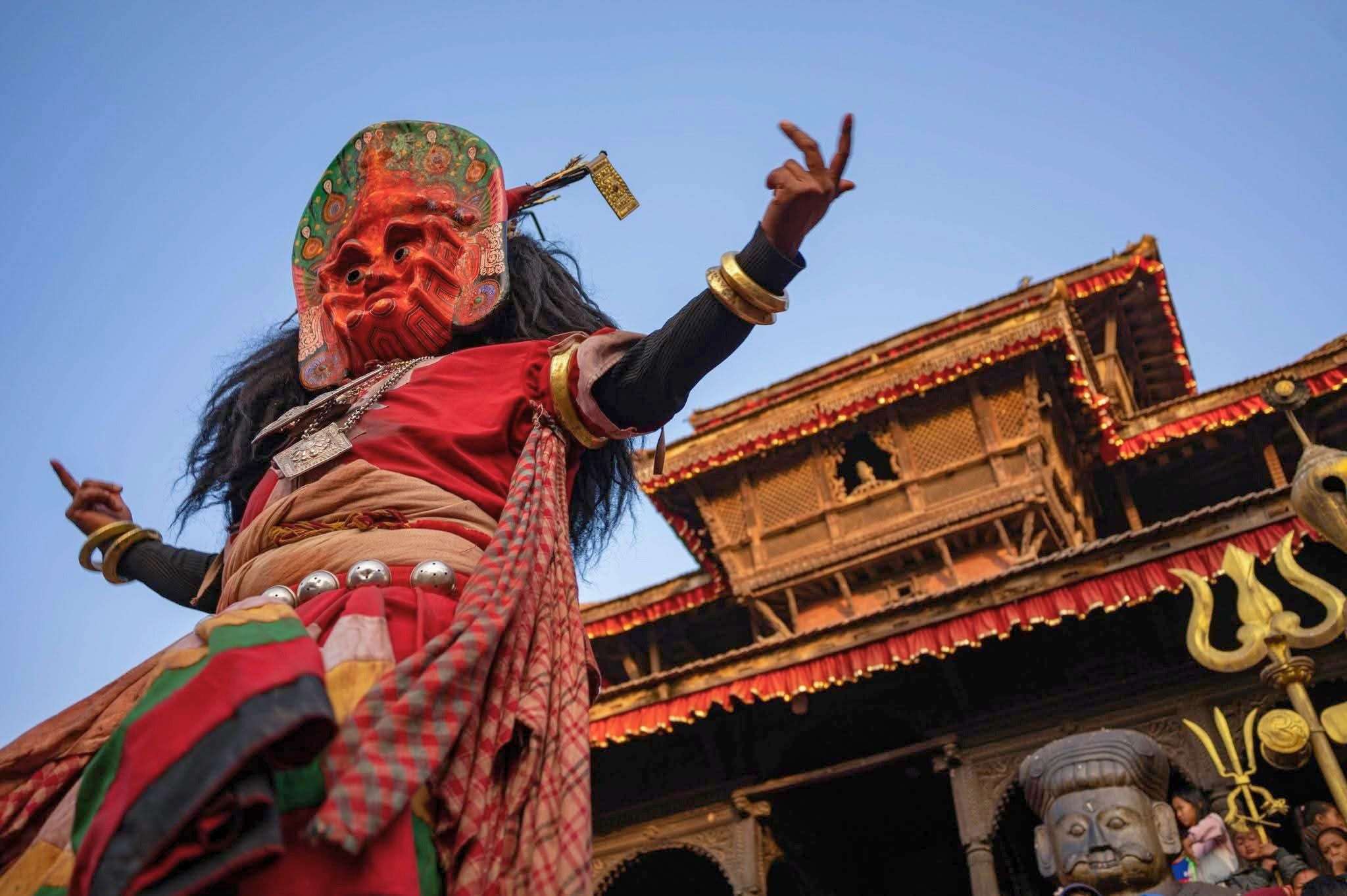
- Costumes. Wikipedia describes children in long skirts, a cow headdress and a painted moustache. In Kathmandu, The Kathmandu Post says a male family member often wears the cow costume and face paint.
- Real calves. Spotlight Nepal says some families lead a real calf, bathed, garlanded and marked with tika (a blessing mark). Others use cow masks or bamboo figures.
- Women and children. The Kathmandu Post says a woman who takes part may dress as Radha, with a boy as the baby Krishna.
- Gifts. People along the route hand food and money to the marchers, such as fruit, beaten rice, curd and bread.
- A set route. The Post says families follow a fixed route called the Sa La. In Kathmandu it passes Hanuman Dhoka, where Wikipedia says a priest prays for the dead.
The Himalayan Times said in 2025 that the festival was banned after the royal takeover of 2017 BS (1960) and revived in 2033 BS (1976).
Why is Gai Jatra full of satire?
Gai Jatra is also the day for jokes, dressing up and poking fun at people in power. After the morning processions, Spotlight Nepal says the streets fill with dances, comedy and satirical plays. Wikipedia says male comedians often dress as women, and that the humour has grown sharper and more political since the 1900s, including on television.
The Himalayan Times describes the festival as a platform for satire about political and social wrongs. A 2014 Kathmandu Post opinion piece says the Newar tradition of satire is performed especially during Gai Jatra and Indra Jatra, and that it carried on in Newar towns despite strict censorship under the Ranas.
The stage shows have faded, though. Republica reported comedians saying that Kathmandu’s halls were once booked weeks ahead for Gai Jatra shows, and that much of the satire has now moved to social media. We can’t list any shows for 2027, and most would be in Nepali.

Where can you see Gai Jatra in Kathmandu and Bhaktapur?
The best places are Kathmandu’s old city around Hanuman Dhoka and Basantapur, and Bhaktapur’s old town around its Durbar Square. Patan and Kirtipur also take part, in their own way.
| Place | What to expect | Source |
|---|---|---|
| Kathmandu, Hanuman Dhoka and Basantapur | Cow processions pass through the palace square and the main old city streets, mostly on the one day | The Kathmandu Post, Wikipedia |
| Bhaktapur, around Durbar Square and Taumadhi | Chariots for the dead, Ghintang Ghisi stick dance and masked dances for about a week | The Himalayan Times, Republica, Wikipedia |
| Patan (Lalitpur) | Similar processions with less public involvement. Lalitpur’s own Mataya festival draws bigger crowds | Wikipedia, The Kathmandu Post |
| Kirtipur | Marchers dress as gods and goddesses, not cows | Wikipedia |
Our guide to Kathmandu Durbar Square shows the layout of the palace area.
Is Bhaktapur’s Gai Jatra bigger?
Bhaktapur’s Gai Jatra lasts longer than Kathmandu’s, and local reports describe it as more varied. We found no crowd figures, so we can’t say it’s larger. Sources differ on its length.
| Source | Length in Bhaktapur |
|---|---|
| Republica, quoting local cultural experts | 9 days and 8 nights, from Janai Purnima to Krishna Ashtami |
| Nepal Traveller, 2022 | 9 days |
| Spotlight Nepal, 2026 | 8 days |
| The Himalayan Times, 2015 | About a week, until Krishna Janmashtami |
CalendarLabs lists Krishna Janmashtami on 25 August 2027. If the pattern holds, Bhaktapur’s festival would run from about 17 or 18 August to 25 August 2027. That’s our estimate from the calendar, not a published schedule.
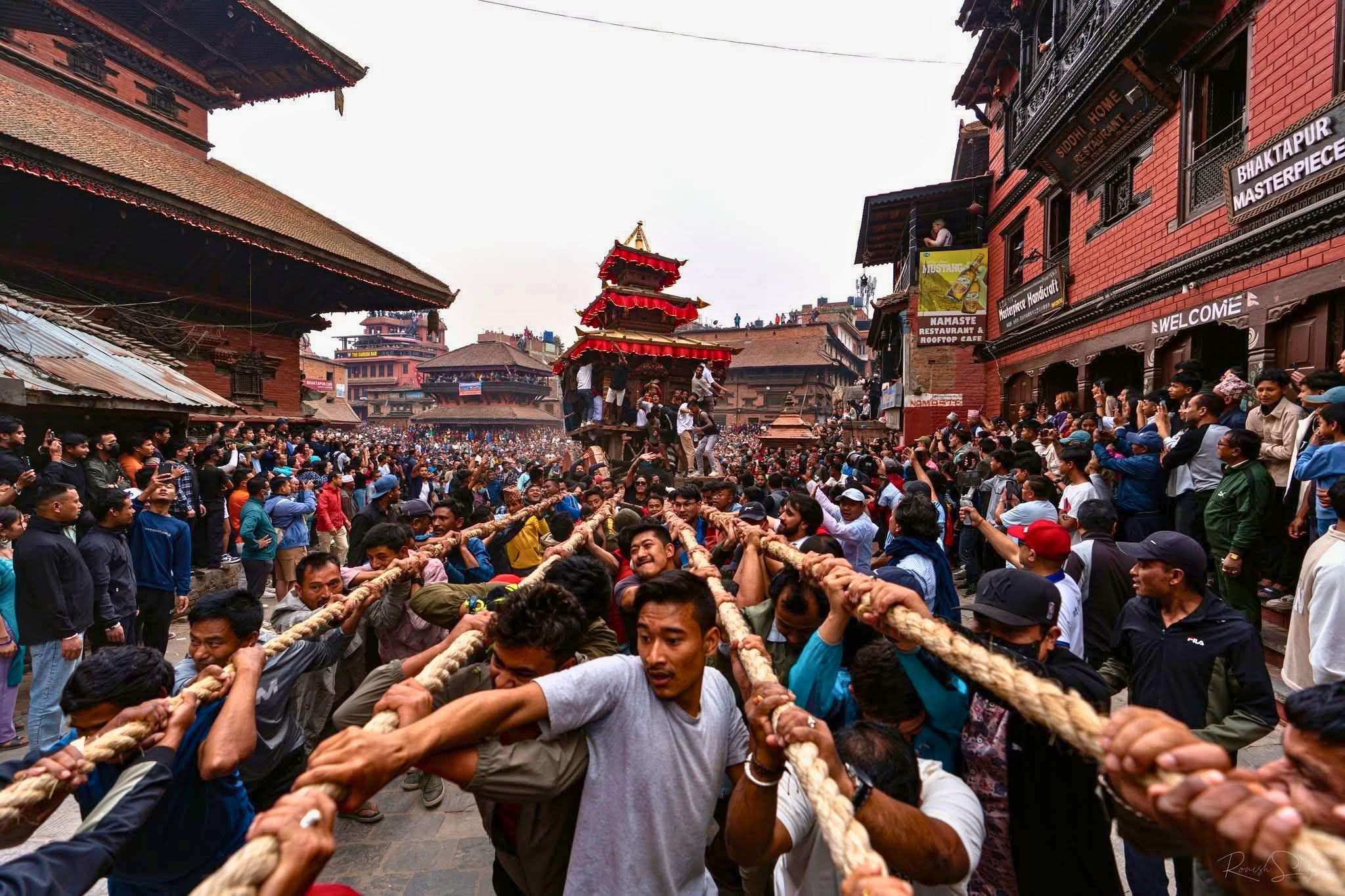
Bhaktapur has its own customs. Wikipedia says families build a taha macha, a bamboo chariot wrapped in cloth with a photo of the person who died. A large straw chariot of Bhairav, called Bhailya Dya, leads the chariots. The Kathmandu Post says families later take the chariot apart and put its bamboo poles in a river.
The Ghintang Ghisi dance is Bhaktapur’s own. Dancers form a long line and strike sticks in pairs. The Himalayan Times says each group starts in its tole (neighbourhood), goes to Bhaktapur Durbar Square, circles the nearby streets and ends back at the square. It names toles such as Taumadhi, Sukuldhoka, Inacho and Golmadi on the route. Republica adds that the municipality runs a dance contest with cash prizes. Our guide to Bhaktapur Durbar Square has the layout.
How should visitors behave around grieving families?
Treat each procession as a family’s act of mourning, even when it looks like a parade. These are our own suggestions, not official rules.
- Watch from the side. Let the families pass and don’t walk into the procession.
- Don’t photograph the families up close. Many marchers have lost someone in the last few months. If you take a wide picture of the street, leave out close-ups of faces, and stop if anyone objects.
- Laugh with the comedy, not at the mourners. The jokes and costumes are part of the day. The families’ grief is real.
- Don’t pose with the costumed children unless a parent clearly invites you.
- Give way in narrow lanes. Processions and dancers fill Bhaktapur’s streets, and the Ghintang Ghisi lines move fast with sticks.
- Dress modestly and keep bags small. Our guide on what to wear in Kathmandu has more.
If someone hands you food, it’s fine to accept it politely. We found no source that says visitors are expected to give anything.

How does Gai Jatra affect traffic and touring?
Kathmandu bans vehicles from the old city centre during Gai Jatra, so plan to walk the last part to the Durbar Square. In 2023, Spotlight Nepal reported that Kathmandu Metropolitan City stopped vehicles entering the city centre, and that the ban continued into a second day. It named Lagan, Gophal, Indra Chowk and Asan among the areas covered.
We found no 2026 or 2027 notice, so the exact streets may change. Thamel is close to Asan and Indra Chowk, so hotel pick-ups and a Thamel meeting point may be slower that morning. That’s our own reading of the 2023 notice.
| Area | Likely effect on 18 August 2027 |
|---|---|
| Kathmandu old city and Durbar Square | Busy with processions. Vehicles barred, going by 2023 |
| Bhaktapur old town | Crowded for about a week with dances and chariots. We found no road notice |
| Swayambhunath, Boudhanath, Pashupatinath | Outside the closure lists we found. We can’t say how busy they’ll be |
| Offices and some shops | Closed for the Kathmandu Valley holiday |
The holiday covers the Kathmandu Valley. The government notice for 2026 said “for all people in the Kathmandu Valley and Newar community”, as reproduced by Pradhan and Associates. Government offices and banks in the valley are likely to close, so do any banking the day before.
Our Kathmandu half day tour goes right into the Durbar Square area, and the Bhaktapur day tour visits Bhaktapur’s old town. Tell us your date when you ask, so we can plan around the processions.
Is Gai Jatra worth planning a trip around?
Gai Jatra is worth seeing if you’re in the valley in mid to late August 2027 and don’t mind monsoon weather and crowds. Kathmandu’s processions are mostly on the morning of 18 August. Bhaktapur gives you more days to catch the dancing, likely up to 25 August.
August is in the monsoon, so pack for rain. Our guide on the best time to visit Kathmandu covers the season. Indra Jatra follows in mid-September 2027, so see our Indra Jatra in Kathmandu page if you’re staying on.