
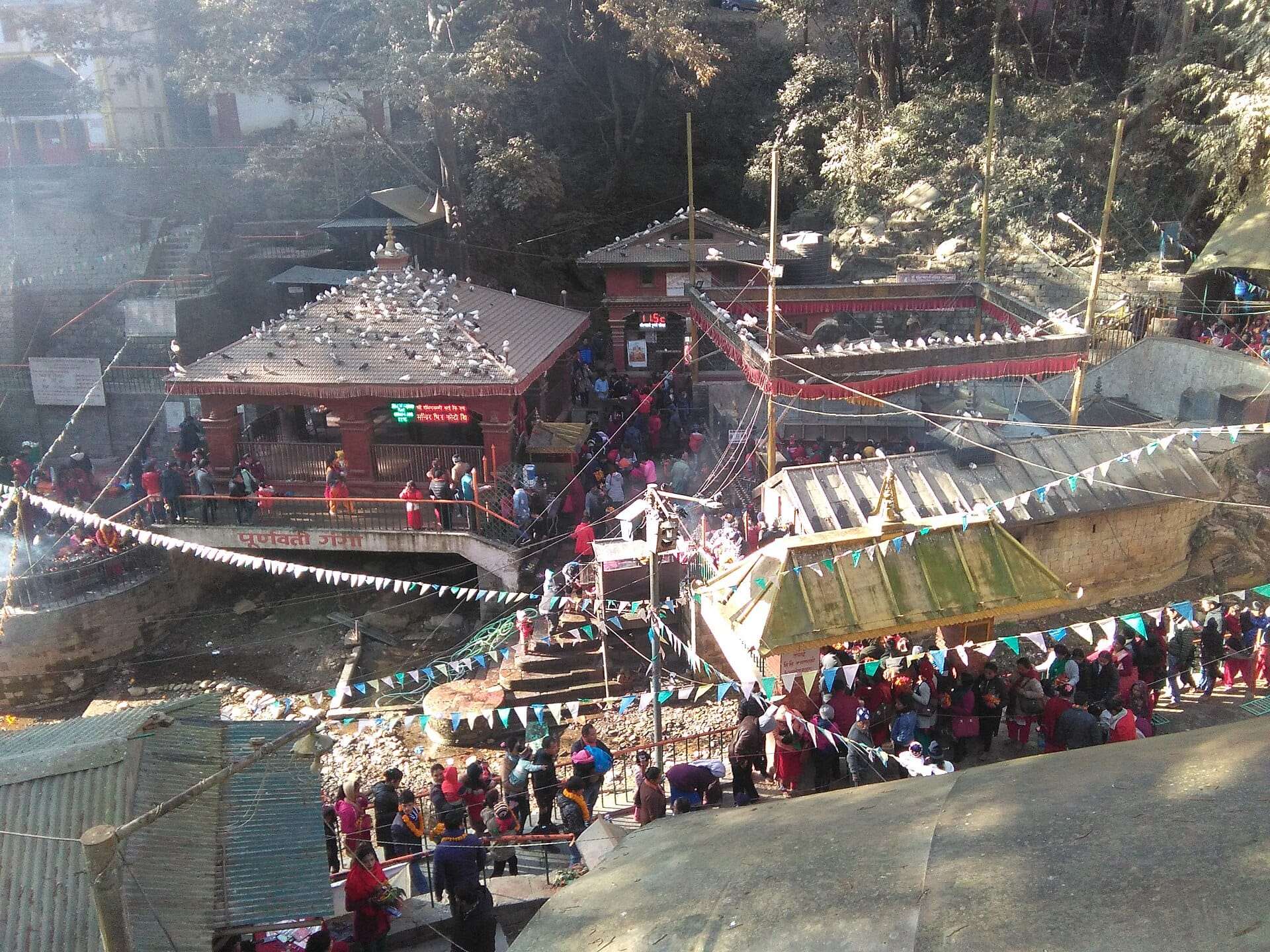

What is Dakshinkali Temple?
Dakshinkali is a Hindu temple to the goddess Kali, at the southern edge of the Kathmandu Valley. The Nepal Tourism Board calls it one of the best-known Shakti Peeths (goddess shrines) in Kathmandu, and says the name means “Kali of the south”.
Wikipedia gives two explanations for the name. One links “dakshina”, a gift given to a priest with the right hand, to the goddess’s right hands, which show blessing. The other links it to the south, where Yama, the god of death, is said to live. Either way, the temple does sit in the south of the valley.
The goddess here is shown with her right foot on the chest of Shiva, according to Wikipedia. The Rising Nepal, reporting in October 2024, calls the temple one of the major Shaktipeeths of the Kathmandu Valley.
What does the shrine look like?
The image of Kali is open to the sky, under a gilded canopy held up by four golden serpents. Both Nepali Times and Nepal Traveller describe it this way. They also list an image of Ganesh, seven mother goddesses (the Ashtamatrikas) and a stone Bhairav close to Kali.
Nepali Times adds that a simpler temple above the main shrine is dedicated to Kali’s mother.
How old is it?
Nepal Traveller dates the temple to the 14th century, in the Malla period. Both it and Nepali Times tell the same legend. Kali appeared to a Malla king in a dream and told him to build a temple at a spot he didn’t know. A stone image of the goddess was then found there.
We found no inscription or archaeology report that dates the present shrine. Onlinekhabar says the hilltop at Pharping was the shrine’s original site, before it moved down to the gorge.
Where is Dakshinkali, and how far is it from Kathmandu?
Dakshinkali sits in a forested gorge where two streams meet, about 1 km south of the town of Pharping. Wikipedia and Nepal Traveller both give that 1 km figure. Wikivoyage places the temple complex where the Bagmati River enters a gorge through the Mahabharat Range.
It’s in Dakshinkali Municipality, in Kathmandu District. Sources give different distances from the city, partly because they measure from different points.
| Measure | Figure | Source |
|---|---|---|
| Kathmandu to Dakshinkali | 22 km | Nepal Tourism Board, Nepal Traveller (2020) |
| Kathmandu to Dakshinkali | About 17 km south | Onlinekhabar (2022) |
| Kathmandu to Dakshinkali | 19 to 20 km, and 22 km elsewhere on the page | Nepal Hiking Team (2026) |
| Old Bus Park to Pharping Bazar | Almost 19 km | Onlinekhabar (2016) |
| Kathmandu to Pharping | About 23 km | Wikipedia |
| Thamel or Kantipath to Pharping by taxi | About 45 minutes | Wikivoyage (July 2024) |
| Kathmandu to Dakshinkali | About 1 hour | Nepal Traveller (2020) |
By our own map measurement, the temple is about 13 km in a straight line from Thamel. Roads wind, so allow about an hour each way, and more on Saturdays.


When is Dakshinkali Temple busiest?
Tuesdays and Saturdays are the busiest days, because that’s when most animal sacrifices take place. The Nepal Tourism Board, Nepal Traveller and Onlinekhabar all say this. Nepal Traveller says Saturday is the busier of the two.
Dashain, the autumn Hindu festival, brings far larger crowds. The Rising Nepal and Onlinekhabar both report big numbers at the temple during the festival. The Kathmandu Post reported in 2016 that devotees visit Dakshinkali in the early morning during Navaratri, the first nine nights of Dashain. See our Dashain page for the festival itself.
Opening hours
We found no official timetable, and the two sources we found disagree.
- Wikipedia: The temple usually closes around 11:30 am for rituals, and reopens the next day.
- Nepal Hiking Team, a tour company (July 2026): It closes around 11:30 am for cleaning and puja (worship), and reopens at 1 pm.
Plan to arrive in the morning. Nepal Hiking Team also suggests early visits to avoid the crowds.
What happens at the animal sacrifices?
Animal sacrifice is the main form of worship at Dakshinkali. Wikipedia says the animals are mostly cockerels and uncastrated male goats. Nepali Times also mentions ducks. The Nepal Tourism Board says Nepal’s Shakti Peeths never accept female animals for sacrifice.
Nepal Traveller says butchers carry out the sacrifice in front of the image of Kali. The animals are then taken to a hut behind the temple, cleaned, cut up and cooked into a feast. Devotees offer them hoping for a wish to be granted. The Nepal Tourism Board notes the wooded site is also a popular picnic spot.
Not every devotee sacrifices an animal. Nepal Traveller says some crack coconuts instead, and notes that some Hindus question the practice.
How should visitors behave on sacrifice days?
Stay back and keep out of the way. This is worship for the families who’ve come, and many have made a vow.
- Don’t film or photograph the sacrifices. Bazar Travels, a tour company, advises against close-up or graphic photos of sacrifices. Nepal Hiking Team says you need permission to photograph rituals.
- Don’t photograph worshippers without asking. Wikivoyage gives the same advice for the whole valley.
- Keep your voice down, and don’t react loudly to what you see.
- Choose another day if you’d rather not see animal sacrifice. Saturdays and Tuesdays are the days to avoid.
If you’re squeamish, know that blood is part of the scene. Nepali Times wrote in 2000 that the stream below the temple often runs red.


Can non-Hindus enter Dakshinkali?
Non-Hindus can visit the temple area, but not the inner courtyard where the image of Kali stands. This comes from tour company guides, not from the temple, so follow any signs and the guidance of staff.
- Bazar Travels: Only Hindus may enter the courtyard with the Kali image. Everyone else watches from the terraces around it.
- Nepal Hiking Team (July 2026): Non-Hindus may not be allowed into the innermost sanctum, but can watch rituals from the outer areas.
Photography rules
Nepal Hiking Team says taking photos of anything inside the main temple is strictly prohibited, selfies included. We found no sign or temple statement to confirm this, so assume no photos near the image of the goddess. Photos of the forest, the gorge and the road are a different matter.
Our what to wear in Kathmandu guide covers temple dress.
Is there an entry fee?
There’s no ticket, according to two tour company guides. Nepal Hiking Team (July 2026) says there are no entry fees and donations are welcome. Bazar Travels says there’s no formal ticket system, though donations are customary.
We found no official notice about fees as of November 2026. Carry small notes for a donation, a snack or parking.


How do you get to Dakshinkali?
Most visitors go by taxi or private car via Pharping, then continue about 1 km south to the temple. The road leaves the Ring Road at Balkhu and heads past Tribhuvan University, according to Onlinekhabar.
| Option | Details | Source |
|---|---|---|
| Taxi from Thamel or Kantipath | About 45 minutes to Pharping, NPR 1,000 to 1,200 | Wikivoyage, July 2024 |
| Bus from Kantipath | About 1 hour to Pharping, NPR 50. Leaves from the last stop between the Nepal Telecom building and Kathmandu Mall | Wikivoyage, July 2024 |
| Bus or microbus | From the Balkhu or Kalanki area, NPR 50 to 250 | Nepal Hiking Team, July 2026 |
Wikivoyage says the bus signs aren’t in English, so ask the conductor. Pharping is the last stop on that route. Our Kathmandu taxi fare guide explains how to agree a fare.
What can go wrong on the road?
Crowds are the first thing to plan for, so expect a slower trip on Saturdays. The Rising Nepal reported in October 2024 that the Dakshinkali mayor asked for quick repairs to the Kathmandu to Makwanpur road after floods. Nepal Hiking Team warns that the streams swell during the monsoon, so keep away from the water.
What can you see in Pharping on the same trip?
Pharping is a small Newar town above the Bagmati, and one of the most important places in the valley for Tibetan Buddhists. Wikivoyage says it’s sacred in Vajrayana Buddhism because Guru Rinpoche (Padmasambhava) is said to have reached full realisation there. Several stops are within a short walk of each other.
| Stop | What it is | Source |
|---|---|---|
| Yanglesho Cave | A cave where Guru Rinpoche is said to have meditated first, about 10 minutes’ walk before the town | Wikipedia, Wikivoyage |
| Rigdzin Drubpe Gatsal Ling | A small retreat monastery beside Yanglesho Cave, founded by Chatral Rinpoche | Wikipedia |
| Shesh Narayan Temple | A Vishnu temple and ponds just below Yanglesho Cave | Wikipedia, Onlinekhabar |
| Asura Cave | A second Guru Rinpoche cave, slightly south of and above the town. Wikivoyage says the walk up takes about 10 minutes, with many steep stairs | Wikipedia, Wikivoyage |
| Vajrayogini temple | A Newar Buddhist temple on the hillside between Yanglesho Cave and the town | Wikipedia |
| Pharping hydropower station | Nepal’s first, built in 1911, and declared a living museum in 2010 | Wikipedia, Onlinekhabar |
Shesh Narayan
Shesh Narayan is one of the four main Narayan (Vishnu) temples of the Kathmandu Valley, along with Changu Narayan, Ichangu Narayan and Bishanku Narayan. Wikipedia says this, and Onlinekhabar agrees. Wikipedia says tradition links it to the Licchavi king Vishnugupta, but that claim is marked as needing a citation.
Onlinekhabar describes a clear pond with fish, and a rock formation above the shrine shaped like a snake’s hood, which gives the temple its name.
The monasteries and caves
Pharping has several Tibetan Buddhist monasteries and retreat centres, mostly of the Nyingma school, says Wikivoyage. Some are closed retreats, so don’t wander into buildings uninvited. Onlinekhabar asks visitors to keep quiet at sacred sites in the town.
Wikivoyage says pilgrims at the caves chant prayers and offer butter lamps, incense and prayer flags. Follow what others around you do, and ask before taking photos inside.
Is Dakshinkali worth a visit, and how long do you need?
It’s worth it if you want to see a busy, working Kali shrine in a forest gorge, and you’re comfortable around animal sacrifice. If you’re not, Pharping’s caves and Shesh Narayan make a calm half day on their own.
We found no reliable source for how long to spend on site. Nepal Traveller and Wikivoyage both put the drive at about an hour or less each way, so a half day covers the temple and a few Pharping stops. Our best day trips from Kathmandu guide compares Pharping and Dakshinkali with other half-day and full-day options.