What is Patan Durbar Square?
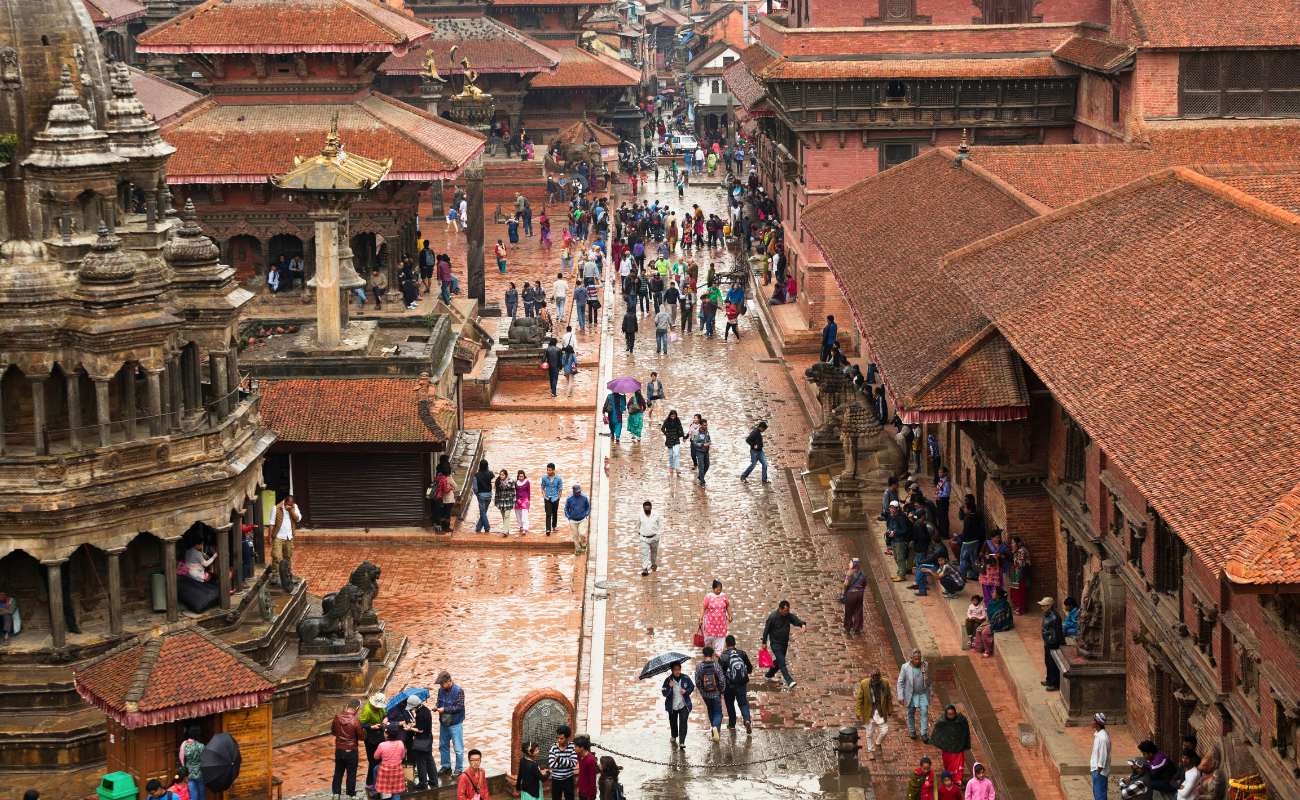
Patan Durbar Square is the old royal square of Lalitpur, a city south-east of Kathmandu. It was the home of the Malla kings of Lalitpur. It’s one of the seven monument zones of the Kathmandu Valley World Heritage property, inscribed in 1979.
Patan is known for its craftspeople. The Nepal Tourism Board calls it the “city of artisans” and says its workers still use repoussé (hammered metal relief) and lost wax casting.
Where is it, and how far is it from Thamel?
The square sits about 5 km south-east of Kathmandu, according to the Nepal Tourism Board. By our own map measurement, it’s 4.9 km in a straight line from Thamel. You cross the Bagmati River to reach it.

Who built Patan Durbar Square?
Most of the buildings you see date from the 1600s, under King Siddhi Narsingh Malla and his son Srinivasa Malla. Older claims are weaker. Wikipedia reports one source that says Patan was founded in the 3rd century BC, and it says there’s little evidence for a Thakuri palace here.
Later Malla kings added to the square, including Purandarasimha, Sivasimha Malla and Yoganarendra Malla.
Here are the main dates, with their sources:
| Date | Building | Builder or event |
|---|---|---|
| 1563 | Char Narayan Mandir | Construction begins (Nepali Times) |
| 1627 or 1628 | Sundari Chowk | Siddhi Narsingh Malla. Nepali Times says 1627, the Kathmandu Valley Preservation Trust (KVPT) says 1628 |
| 1627 | Vishveshwara (Vishwanath) Mandir | Consecrated |
| 1637 or 1667 | Krishna Mandir | Nepal Tourism Board says 1637, Wikipedia says 1667 |
| 1640 and 1667 | Taleju Bhawani Temple | Built by Siddhi Narsingh Malla, rebuilt by Srinivasa Malla after a fire |
| 1680 | Bhimsen Temple | Srinivasa Malla |
| 1693 | Yoganarendra Malla pillar | Erected |
| 1706 | Harishankar Mandir | Built |
| 1730s | Sundari Chowk | Third floor and triple-bay windows added (KVPT) |
| 1734 | Keshav Narayan Chowk | Palace compound replaces a Buddhist monastery (Asianart.com) |
For the wider story, see our history of Kathmandu Valley guide.
What is there to see in the square?
The square has a line of temples and a palace with several courtyards. These are the main named sights.
Temples
- Krishna Mandir: A three-storey stone temple with 21 golden pinnacles. Its first-floor carvings show the Mahabharata, and its second-floor carvings show the Ramayana. Thousands gather here during Krishnastami, according to Wikipedia.
- Bhimsen Temple: Known for three linked golden windows. The Newa people worship Bhimsen as a god of trade. Tourists and photos inside aren’t allowed.
- Vishveshwara (Vishwanath) Mandir: A Shiva temple between Krishna Mandir and Bhimsen, with two stone elephants at the door. Its roof struts have erotic carvings. The elephants still show cement patches from repairs after a 1989 collapse.
- Char Narayan Mandir: A 16th-century temple, rebuilt after it fell to its plinth in 2015.
- Harishankar Mandir: A three-storey temple from 1706, rebuilt after 2015.
- Taleju Bhawani Temple: The personal goddess of the Malla kings. It isn’t open to the public.
- Yoganarendra Malla pillar: An 8 m pillar with the king’s statue on top.
Palace courtyards
- Keshav Narayan Chowk: The north courtyard, now home to the Patan Museum.
- Mul Chowk: The central and largest courtyard, with the Vidya Temple at its centre. Statues of the river goddesses Ganga and Jamuna stand at the Taleju shrine door.
- Sundari Chowk: South of Mul Chowk, and the earliest surviving courtyard in the square, according to Nepali Times. It holds Tusha Hiti, a sunken royal bath with stone deities.
- Bhandarkhal Tank: A royal water tank that the museum gives access to, according to Nepali Times.
The Patan Museum
The Patan Museum is one of the best reasons to come. It opened in 1997 in the old palace, after a restoration of more than a decade funded by Nepal and Austria, led by the Austrian architect Götz Hagmüller.
The collection has about 1,100 objects, with about 200 on view across eight themed galleries, according to Nepali Times in 2024. Most are cast bronzes and gilt copper repoussé. Carved arms rescued from Char Narayan after 2015 are shown here too.

What did the 2015 earthquake do to the square?
The April 2015 earthquake collapsed several temples, and most of the best-known ones have now been repaired or rebuilt. KVPT led much of the work with the Department of Archaeology. Nepali Times said in September 2022 that several temples were still in progress, and we found no later overall count.
| Building | What happened | Status and date |
|---|---|---|
| Char Narayan Mandir | Collapsed to its plinth | Restoration celebrated in January 2020 |
| Harishankar Mandir | Collapsed almost completely | Rebuilt by 2019 with about 90% of recovered material, per Nepali Times |
| Krishna Mandir | Stood through the quake | Three-year conservation finished in 2018 |
| Yoganarendra Malla pillar | Knocked down | Pillar re-erected in 2016, statue back by 2017 |
| Bhimsen Mandir | Needed strengthening | Reopened by September 2022 |
| Vishveshwara Mandir | Brick walls fell, timber held | Walls rebuilt |
| Sundari Chowk | East wing collapsed | Finished in 2017, opened to the public from October 2017 |
One date conflicts. Wikipedia’s photo caption shows Harishankar restored in 2023, while Nepali Times describes the three storeys going up from 2017 to 2019.
Nationally, the Department of Archaeology says 825 of 920 damaged monuments had been rebuilt by August 2026. Our Kathmandu earthquake restoration tracker follows the wider work.
How long do you need?
Allow about 2 to 3 hours for the square and the museum. This is our estimate. One published seven-site tour gives Patan 60 minutes, which is tight if you want the museum.

What is a good walking route?
This route covers the temples first, then the palace.
- Start with Char Narayan and Krishna Mandir.
- Walk on past the Yoganarendra Malla pillar and Harishankar Mandir.
- Continue to Vishveshwara Mandir and Bhimsen Temple.
- Cross to the palace and enter the Patan Museum at Keshav Narayan Chowk.
- Allow time for the galleries and any open courtyards.
- Finish with a five-minute walk north to the Golden Temple.
What is the best time of day to visit?
Late morning works well, because the museum opens at 10:30 am in both sources we found. We have no official guidance on crowds or light, so treat this as a suggestion.
Check the day too. Asianart.com lists the museum as closed on Tuesdays.

What are the rules for dress and photography?
Dress modestly, as you would at any working temple. Bhimsen Temple doesn’t allow tourists or photos inside, and the Taleju Bhawani Temple isn’t open to the public.
We couldn’t find published dress or photo rules for the square as a whole. Our guide on what to wear in Kathmandu covers the general advice.
- Ask before you photograph people at worship.
- Take off your shoes if you enter a shrine.
- Ask at the door if you aren’t sure whether you can go in.
Are there steps, and is it accessible?
One report says the square offers access for wheelchair users. That comes from an Onlinekhabar article of November 2025 by a tour operator, with no detail on surfaces or ramps.
Tusha Hiti is sunken, so it means steps. We have no measurements, so ask before you book if you have limited mobility. Our steps and mobility guide compares all the sites.

Which festivals happen here?
Krishnastami is the big event at Krishna Mandir, when thousands of devotees come to the temple, according to Wikipedia. We don’t have a date page for it, so check locally.
How do you get there?
A taxi is the simplest way from Thamel, and our Kathmandu taxi fare guide covers prices. Wikivoyage lists these other options, without a recent date:
- Microbus: From Ratnapark in central Kathmandu.
- Ring Road bus: Ask for “Patan”, then walk about 15 minutes to the square.
- On foot: About 90 minutes from Thamel, crossing the Bagmati.
Wikivoyage warns that local buses are old and rough, and not well suited to people with disabilities.

What is near the square?
Several sites are close to the square, and most are walkable.
- Hiranya Varna Mahabihar (Golden Temple): A Buddhist monastery, also called Kwa Bahal, about five minutes from the north end. Wikipedia gives both the 12th century and 1409 for its date. The Tourist Guide Association lists NPR 100, while Wikivoyage lists NPR 50.
- Mahabouddha: A terracotta Buddhist monument, a short walk south-east. The Nepal Tourism Board calls it 14th-century, while The Longest Way Home says it was built from 1564 to 1610.
- Kumbheshwar: A five-storey temple from 1392.
- Rudra Varna Mahavihar (Uku Bahal): Another named monastery in Patan.
- Ashoka stupas: Four old stupas mark the corners of the city, at Pulchowk, Lagankhel, Ibahi and Teta.
Further south, Bungamati and Khokana are stops on our Patan day tour.
How do you visit with a guide or alone?
You can visit alone with no booking. Buy your ticket at the counter in Nepali rupees, and keep it with you for the museum. Allow time to read the museum labels, which explain the art techniques.
A guide helps most with the palace courtyards, because access changes and the history is hard to follow without help. Our page on do you need a tour guide in Nepal goes through the choice.
Four tours on this page include the square. For a full day here with two old villages nearby, the Patan day tour is the closest fit. For a quicker visit combined with another old city, compare the Kathmandu Valley day tour.