Can non-Hindus enter Pashupatinath Temple?
No. Non-Hindu visitors can’t enter the main temple at Pashupatinath. The Pashupati Area Development Trust (PADT), which runs the site, says “the main sanctum is restricted to Hindus only”. Pashupatinath is a Hindu temple complex on the Bagmati River in Kathmandu.
Sources draw the line in slightly different places, so here’s who says what.
| Source | Wording on who can enter |
|---|---|
| PADT, pashupati.gov.np | Non-Hindu visitors aren’t permitted inside the main sanctum |
| Nepal Tourism Board, Pashupatinath page | The main temple complex is open only to Hindus |
| Nepal Tourism Board, fee page | Tourists can view the temple from the back premises |
| pashupatinathtemple.org | Only followers of Hinduism can enter the main temple |
Treat the main complex as closed unless you’re Hindu. Staff at the gate have the final say, and our Pashupatinath guide covers the site as a whole.
What can non-Hindus see?
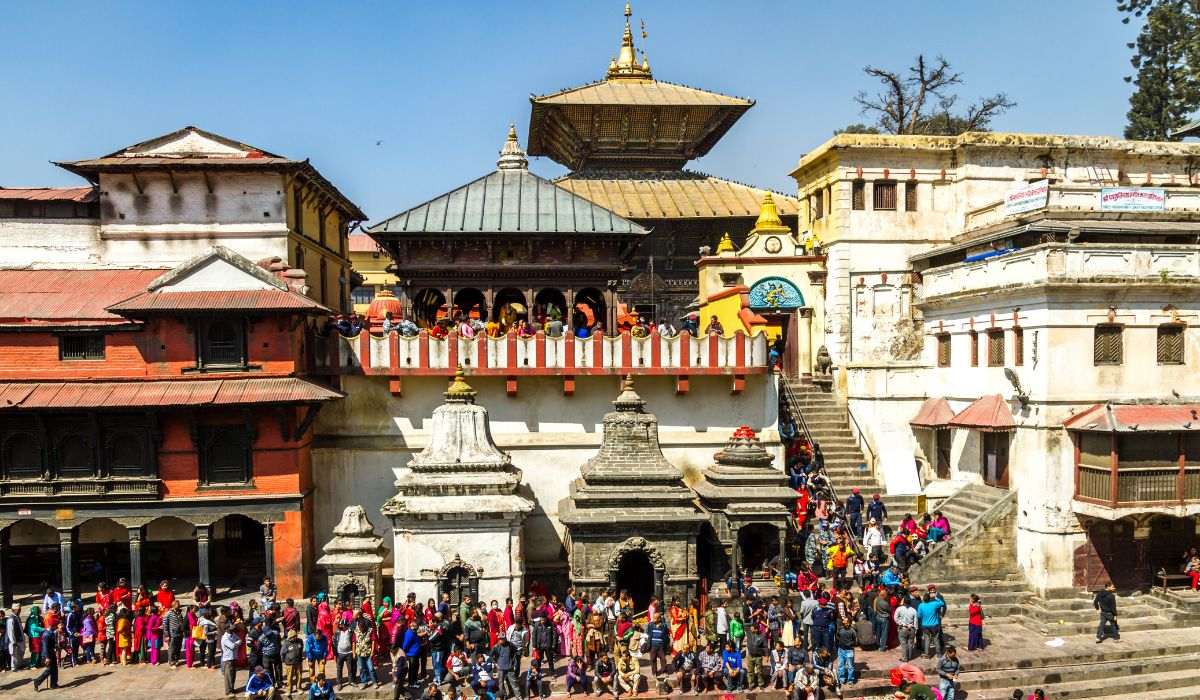
Non-Hindu visitors can see a lot, including the ghats, gardens and surrounding shrines. PADT also says they can watch the evening aarti (the lamp ceremony) from the eastern bank of the Bagmati. The Nepal Tourism Board mentions watching from the terraces across the river.
PADT describes several monuments around the main temple. It says only that non-Hindus may visit “surrounding shrines”, without listing them one by one, so ask before you walk into any working shrine.
| Place | What PADT or NTB says |
|---|---|
| Main temple | Hindus only. Built by the Licchavi king Supuspdev, according to PADT |
| Panchadewal | Five temples inside a large courtyard |
| Kirateshwar | Open shrine on a hilltop across the Bagmati |
| Visworupa | Dome-style temple about 108 feet tall, in the Mrigasthali forest |
| Gorakhnath | Temple in the Mrigasthali area, dating to the 18th century |
| Ramghat temple | White-domed temple with a Vishnu image |
| Guhyeshwari | PADT calls it the second most important temple after Pashupatinath. The Nepal Tourism Board says non-Hindus can’t enter |
The cremation ghats are on the same stretch of the river. Please read our guide to the Pashupatinath cremation ghats before you go there.

Who counts as a Hindu at the gate?
We can’t give you a rule, because PADT doesn’t publish one. Wego’s 2026 visitor guide says PADT “does not publish a more detailed identity test” on its visitor pages, and it advises asking temple staff and not assuming.
People search for specific answers about Buddhists, Sikhs, Jains, Muslims and foreign-born Hindus. We found no official statement on any of these groups, so we won’t guess. Don’t assume that your nationality, appearance or fee category settles the question. Ask staff.
If you’re Hindu and from outside South Asia, speak to staff at the gate politely and accept their decision. If you’re turned away, the eastern bank and the outer grounds remain open to you.
What should you wear?
Wear modest clothes that cover your shoulders and knees. PADT says “modest and traditional dress is required”, and that “shorts, sleeveless tops, and western casual wear are not permitted on temple grounds”. It also says shoes must come off before you enter any shrine.
PADT’s wording on “western casual wear” is broad, and we don’t know how strictly it’s applied in the outer grounds. Long loose trousers or a long skirt and a covered top are the safe choice for anyone. Our guide on what to wear in Kathmandu has more detail for other sites.

Can you bring leather?
No leather inside the main complex. The Nepal Tourism Board says leather items must be left outside. The board lists shoes, belts and cameras. PADT’s own visitor information doesn’t mention leather.
This rule matters mainly to Hindu visitors going into the main temple. Other visitors may still prefer not to carry leather near shrines, and it’s simple to choose a fabric bag and belt for the day.
Can you take photos at Pashupatinath?
Photography is banned inside the main sanctum and during religious ceremonies, according to PADT. It allows photos in exterior areas, at the ghats and in public areas if you’re respectful. The Nepal Tourism Board’s page is stricter, and simply says “photography is strictly prohibited”.
So the two main sources differ. Follow signs and staff instructions where you are, because they override any website.
We’d go further than PADT here, and we ask you to as well:
- Don’t photograph cremations, mourners or families at the ghats. Wego puts it well: public ghats aren’t “a licence to photograph” worshippers, priests or grieving families.
- Don’t photograph worshippers or priests without clear permission. Don’t point a camera into the main gate.
- Don’t fly a drone. PADT requires prior written permission.
When is the temple open?
The grounds are generally listed as open from 4 am to 9 pm, but the sources conflict on the middle of the day and on aarti. PADT’s own home page shows two different evening schedules, so we don’t state one time as fact.
| Source | What it says |
|---|---|
| PADT home page, darshan schedule | Evening aarti 5 pm to 7 pm, night aarti 7 pm to 8 pm |
| PADT home page, day schedule | Evening aarti 6.30 pm to 7.30 pm |
| pashupatinathtemple.org | Open 4 am to 9 pm, closed from noon to 5 pm |
| Wego, citing PADT | Inner gates close at 2 pm, then reopen for aarti at 6 pm in winter and 7 pm otherwise |
Confirm the day’s timing with your guide or hotel before you set out. Our Pashupatinath and Boudhanath tour goes at dusk, and we confirm the aarti time on the day.
How much does it cost?
Foreign visitors pay NPR 1,000, as listed by the Nepal Tourism Board in November 2026. The board lists it “per day per entry”, so leaving and coming back may mean paying twice. Other SAARC nationals pay NPR 1,000 too, and Indian and Nepali nationals enter free.
The Kathmandu entry fees guide covers fees at the other sites and where sources disagree.
How should you behave at the temple?
Behave as you would at any busy place of worship where people are praying. PADT asks everyone to follow temple guidelines and to respect the sacred environment.
- Stay out of the way of worshippers and funeral groups on the paths and bridges.
- Keep your phone silent during aarti, and stand where stewards direct you. Wego recommends both.
- Don’t climb on shrines or walls.
- Take your shoes off before entering any shrine, and leave them where staff direct.
- Ask before you step into a courtyard or shrine if you aren’t sure.
During Maha Shivaratri at Pashupatinath, crowds are far larger and the usual routes may change, so plan that day separately.